Extra fingers, made-up facts and ads nobody asked for. AI slop is everywhere, and some of it carries expensive logos. Here is what AI slop is, how it gets past smart teams, and the one step that lets you catch it before it goes out under your name.
What is AI slop?
In December 2025, Merriam-Webster picked "slop" as its word of the year. Its definition: "digital content of low quality that is produced usually in quantity by means of artificial intelligence." (TechCrunch)
Two parts of that definition matter. Low quality. And in quantity. One odd image is a mistake. A thousand a day is a business model.
You have seen it. The stock photo where a hand has six fingers. The product description that says nothing in forty words. The email that opens "In today's fast-paced world." Nobody wrote it. Nobody read it. It went out anyway.
AI slop ads: when it wears a logo
Slop on a meme page is a joke. Low quality AI content with a brand's name on it is a bill.
Two holiday seasons show the pattern.
In December 2025, McDonald's Netherlands released a 45-second Christmas ad made with generative AI. It was removed three days later, after viewers called it creepy. The company said, "we have decided to remove our AI-generated Christmas advert." (eWeek)
Coca-Cola's AI holiday ads drew criticism in 2024 and again in 2025. Some viewers called the 2024 ad "soulless." (Nielsen Norman Group)
Here is the part that should worry a Head of Brand. Neither was a lazy job. The Sweetshop, a production house behind the McDonald's ad, said its team worked for seven weeks and produced thousands of takes. (eWeek) Coca-Cola's 2025 campaign reportedly took five AI specialists about a month and roughly 70,000 clips. (Nielsen Norman Group)
So slop is not a word for effort. It is a word for what the audience sees.
Nobody grades your process. They grade what is in front of them.
How AI slop gets past a brand team
No one sits in a meeting and votes for slop. It gets through in ordinary ways.
- Volume. AI makes more than anyone can read. Review turns into spot checks.
- Speed. The deadline was yesterday, and the draft "looks fine."
- It does look fine. AI output is fluent. The grammar is perfect. The problems are harder to see: a claim nobody can back up, a tone that isn't yours, a detail that was never true.
- The writer checks itself. The same system that wrote the piece says the piece is on-brand. Of course it does.
- Nobody owns the last look. Everyone assumes someone else read it.
Five signs you are about to publish AI slop
- You could swap in another company's name and nothing else would change.
- It uses words your brand never uses.
- It states a fact, a price or a promise nobody on your team confirmed.
- Every sentence is a little too excited.
- The only reader before the customer was the AI that wrote it.
The one step that catches it
AI slop is not an AI problem. It is a release problem. The content was made, then it went out, and nothing stood between those two moments.
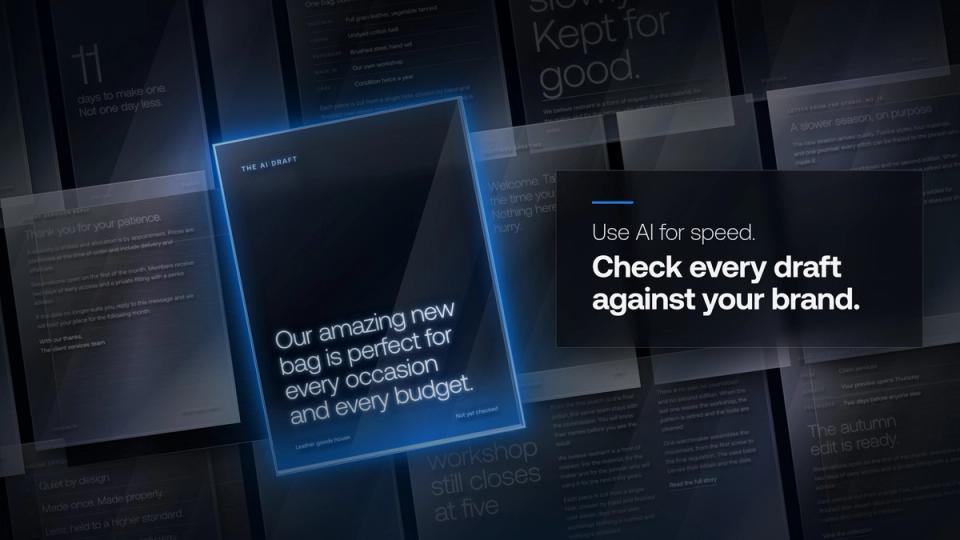
The fix is a check before release, by something other than the writer, against your own standard. Not a general idea of quality. Yours.
That is what LuxeDetect™ is built to do. We call the category AI Brand Integrity Infrastructure: an independent check between the AI that writes and the customer who reads. Think of a release gate, which is a checkpoint you run content through before it goes out.
LuxeDetect™ never writes content. It scores AI-written content against your LF1000 Brand Benchmark, which is your brand's rules written so they can be checked. Each piece gets a LuxeFactor™ Score with the reasons. The first release is a dashboard: paste in the copy, choose the brand, see the score and why.
The takeaway
Everyone laughs at AI slop until it has their logo on it. You don't fix it by banning AI or by asking people to try harder. You catch it by checking each piece against your own standard before anyone outside the building sees it.
Request early access to LuxeDetect™.

We are building AI Brand Integrity Infrastructure for luxury, and global enterprise brands. LuxeDetect™ evaluates every AI-generated output before it goes live. We measure alignment with brand tone, style, and standards, then enforce tiered actions at the release gate so off-brand content never reaches the public.
As AI spreads across CRM, CX, and marketing, manual review and generic safety filters cannot protect brand voice at scale. Our focus is to safeguard brand equity from AI generated content risks. We’ve been accepted into the Vector Institute Fastlane Build Phase. Stay tuned for launch updates.