Your team can write a month of content in an afternoon with AI. Your client will notice the one piece that sounds nothing like them. Here is how to use AI for content creation in four steps, with a check you run on every piece, so you see that one before the client does.
The real risk is not bad writing
AI copywriting is good now. Clean, quick, on topic. That is the trap. A draft that reads well gets waved through.
For an agency, the risk is sharper. You write for ten clients, each with a different voice. By Thursday, Client A's warm and playful starts to sound like Client B's formal and precise. Nobody notices until the client does.
So a good AI content strategy is not "use AI more." It is "use AI for speed, and keep a check for quality."
How to use AI for content creation in four steps
Four steps. The third is the one most teams skip.
Step 1. Brief it like a new hire
You wouldn't hand a new writer a topic and nothing else. AI needs the same brief a person does.
- Who the reader is, in one line.
- Three or four examples of copy the client loved.
- The words this client never uses.
- The claims that need proof.
Keep one brief per client. Never reuse one client's brief for another.
Step 2. Draft fast
This is the part AI is good at. Let it write the first version, the ten subject lines, the five ways into the story. Speed is the point. Don't fall in love with any of it yet.
Step 3. Check it against the client's standard
This is where most teams stop short. They read the draft and ask, "Is this good?" The better question is, "Is this them?"
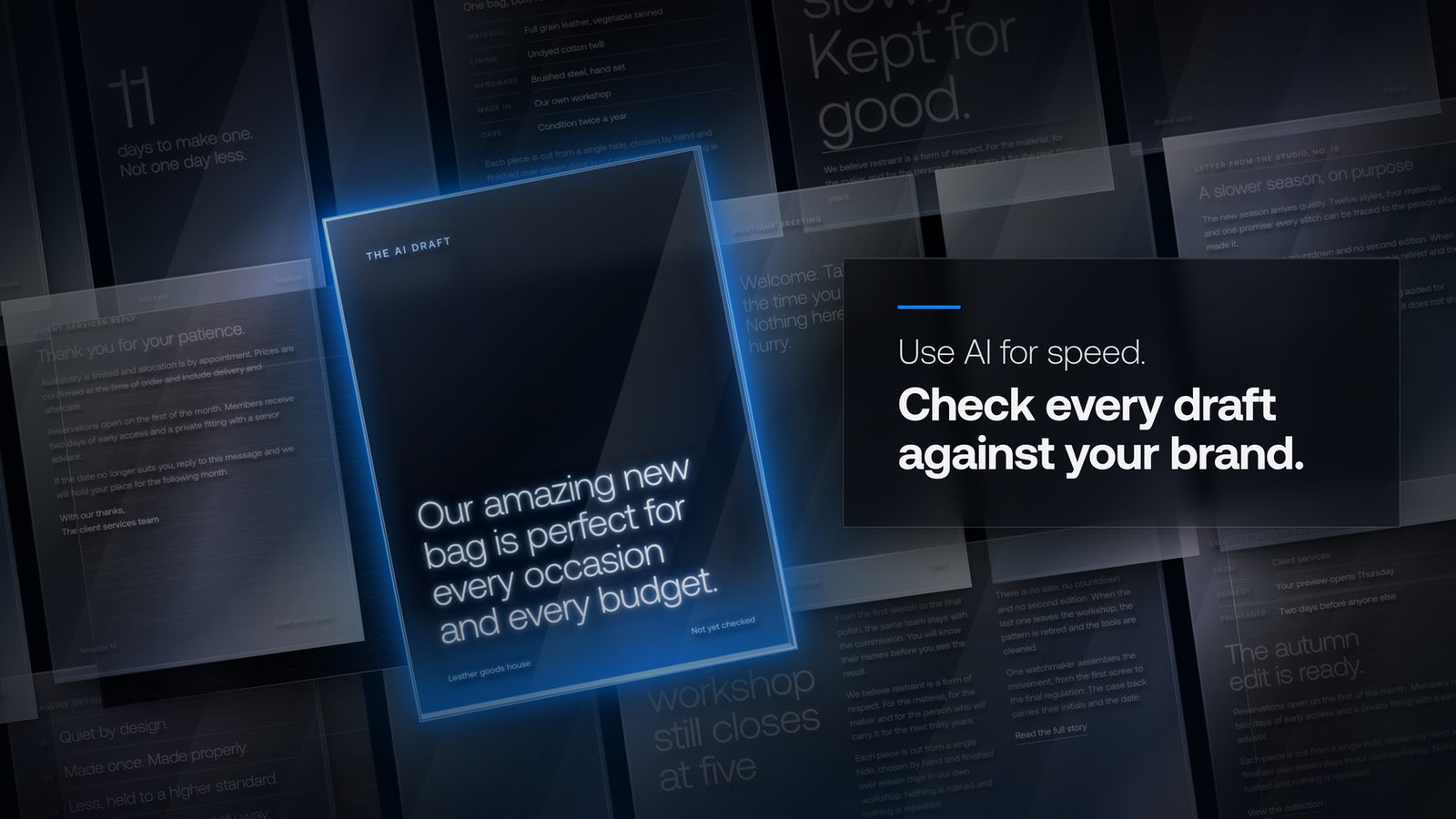
Here is a made-up example. The client is a leather goods house. Its brief says: talk about materials and time, never say "amazing," never mention price.
- The AI draft: "Our amazing new bag is perfect for every occasion and every budget."
- What the brief asks for: "Cut from a single hide. Made to be carried for decades."
Both read well. Only one follows the brief.
A person can catch that in one draft. Across, say, four hundred drafts for ten clients, you need a system. That is what AI content quality control means: every piece checked against the right client's standard, not a sample checked against someone's memory.
And the check should not be the same AI that wrote the draft. A writer grading their own essay will pass it.
"Is this good?" is the wrong question. Ask, "Is this them?"
Step 4. Publish, and keep the proof
When a client asks, "How do you know it's on-brand?" the answer "we review everything" gets harder to say every month.
Keep the result of each check: which piece, which client's standard, what it scored and why. Now the answer is something you can show.
Where LuxeDetect™ fits
LuxeDetect™ is built for steps 3 and 4. We call the category AI Brand Integrity Infrastructure, which means an independent check between the AI that writes and the customer who reads. Think of it as a release gate: a checkpoint you run content through before it goes out.
It never writes content. It scores AI-written copy against each client's own standard. We call that standard the LF1000 Brand Benchmark: the brand's rules, written so they can be checked. Every piece gets a LuxeFactor™ Score with the reasons. The same piece checked against the same version of the standard gets the same result every time.
The first release is a dashboard. Paste in the copy, choose the client's brand, and see the score and the reasons. Send the reasons back to your AI and fix the draft.
The takeaway
Use AI for the draft. Keep a separate check for the voice. Then show every client the score, not just the copy.
Request early access to LuxeDetect™.

We are building AI Brand Integrity Infrastructure for luxury, and global enterprise brands. LuxeDetect™ evaluates every AI-generated output before it goes live. We measure alignment with brand tone, style, and standards, then enforce tiered actions at the release gate so off-brand content never reaches the public.
As AI spreads across CRM, CX, and marketing, manual review and generic safety filters cannot protect brand voice at scale. Our focus is to safeguard brand equity from AI generated content risks. We’ve been accepted into the Vector Institute Fastlane Build Phase. Stay tuned for launch updates.