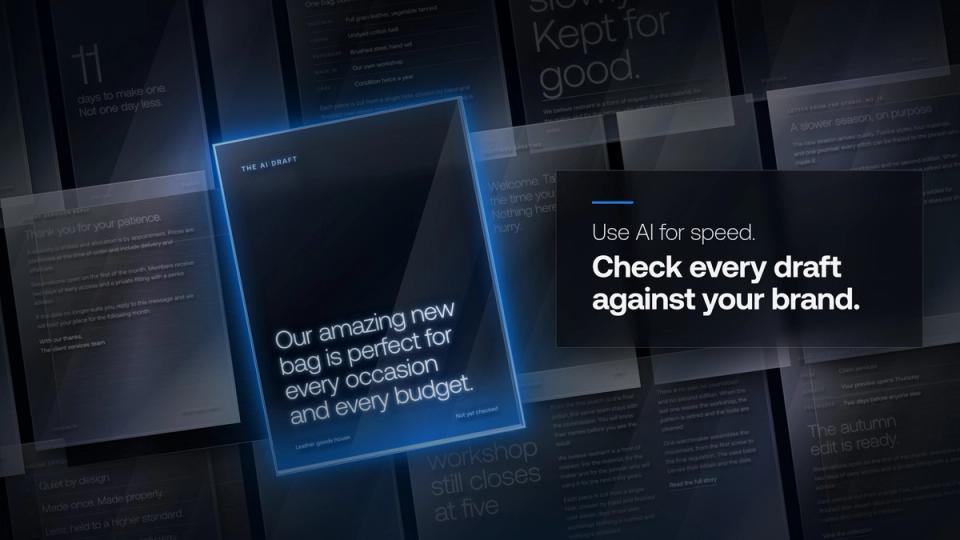
Your brand guidelines tell a designer which font to use. They say nothing about what happens when AI writes 400 emails before lunch. Below is a brand guidelines template with six sections, including the AI section most brands skip. You can copy it today.
What are brand guidelines?
Brand guidelines are the written rules for how your brand looks and sounds. They exist so a hundred people can make things that feel like one company.
For decades, the reader was a person: a designer, a writer, an agency. People read the guide once, absorb it and get better over time.
AI reads it every time and can still drift. It also writes more in a morning than your team writes in a month. A guide written for people needs one more section.
The brand guidelines template
Use these six sections. You probably have the first five. The sixth is the one to add.
- Logo and marks. Versions, the empty margin around the logo, minimum size, what never to do.
- Color and type. Exact values, the fonts, how they pair.
- Voice and tone. Three or four traits, each with a "this, not that" example. These are your brand voice guidelines.
- Words we use and words we never use. A real list, not a mood.
- Claims and proof. What you can say about the product, and what needs a source or a legal line.
- How AI-written content gets checked. What checks it, against which version of these rules, before it goes out.
Section 6, ready to copy
Paste this into your guide and fill in the brackets.
- Where AI writes for us: [emails, product pages, chat replies, social posts].
- The standard it is checked against: [this document, with its version and date].
- Rules that can be checked: [the list from sections 3, 4 and 5].
- What does the checking: [name it. It should not be the same AI that wrote the content].
- When the check happens: before release, on every piece, not a sample.
- What we keep: the result and the reasons for each piece.
- Who owns this section: [name and role].
Write rules that can be checked
Most guidelines are full of rules like "Be warm but professional." A person can work with that. A check can't.
The trick is to turn each soft rule into one you could mark yes or no. Here are brand guidelines examples from a made-up skincare brand.
- Vague: "Sound premium." Checkable: "Never use the words cheap, deal or bargain."
- Vague: "Be confident, not pushy." Checkable: "Never write 'act now.' No exclamation marks."
- Vague: "Be accurate about results." Checkable: "Never promise a result in a number of days."
You won't turn every rule into a yes or no. Tone still needs judgment. But every rule you make checkable is one less rule left to luck.
AI follows a hard rule better than a mood.
Why a section in a document is not enough
Here is the honest limit of any template. A guideline describes the standard. It can't stop anything.
Section 6 only works if something does the checking. That is where LuxeDetect™ comes in. We call the category AI Brand Integrity Infrastructure: an independent check that reads AI-written content against your own rules before it goes out. It works like a release gate, which is a checkpoint you run content through before it goes to the customer.
Your guidelines become your LF1000 Brand Benchmark, which is your rules written so they can be checked. Each piece gets a LuxeFactor™ Score with the reasons. LuxeDetect™ never writes content, so it never grades its own work.
The first release is a dashboard: paste in the copy, choose the brand, see the score and why.
Checklist before you publish your guide
- All six sections are there.
- The never-use list has real words on it.
- Each claim says what proof it needs.
- Section 6 names what does the checking, and it is not the writer.
- The guide has a version and a date.
The takeaway
Your guidelines were written for people. Add one section for the AI that now writes most of your words, and write your rules so they can be checked.
Request early access to LuxeDetect™.

We are building AI Brand Integrity Infrastructure for luxury, and global enterprise brands. LuxeDetect™ evaluates every AI-generated output before it goes live. We measure alignment with brand tone, style, and standards, then enforce tiered actions at the release gate so off-brand content never reaches the public.
As AI spreads across CRM, CX, and marketing, manual review and generic safety filters cannot protect brand voice at scale. Our focus is to safeguard brand equity from AI generated content risks. We’ve been accepted into the Vector Institute Fastlane Build Phase. Stay tuned for launch updates.